Top 10 Viewpoints in China
China's viewpoint geography spans desert plateaus, subtropical karst, volcanic massifs, and the world's densest concentration of pilgrimage mountains. The scale of infrastructure — glass walkways, horizontal cable cars, high-altitude funiculars — deployed at Chinese scenic areas has no parallel elsewhere. These ten represent the range.
1. Yuanjiajie, Zhangjiajie, Hunan
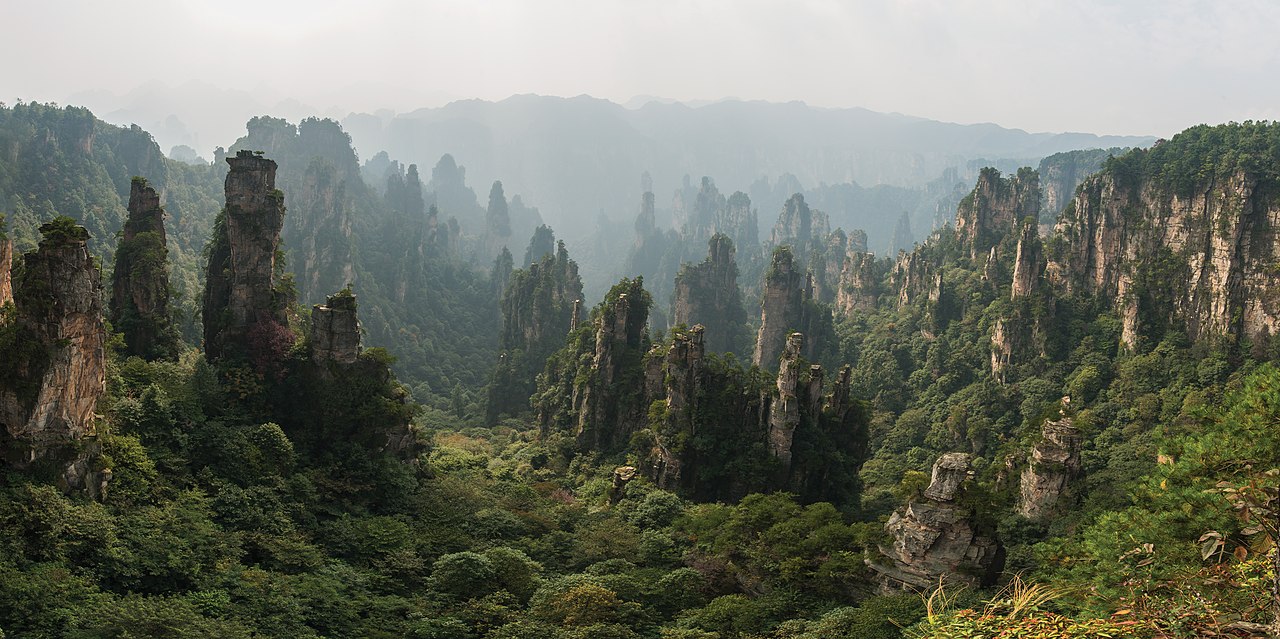
The Yuanjiajie section of Zhangjiajie National Forest Park contains the Hallelujah Mountain (Avatar Mountains), the specific sandstone pillar that inspired the floating mountains in James Cameron's 2009 film. The quartz sandstone columns rise up to 300 metres from the Yuanjiajie plateau at 1,080 metres, draped in subtropical forest. The Bailong Elevator (the world's tallest outdoor elevator at 326 m) provides direct access from the valley floor to the plateau. Morning mist at sunrise is the defining condition — when low cloud fills the valley and the pillars emerge above it, the landscape is genuinely otherworldly. Reached from Zhangjiajie city via bus or taxi; the park's own bus system connects the main sections.
2. Lotus Peak Sunrise, Huangshan, Anhui
Huangshan (Yellow Mountain) is a granite massif with 72 named peaks, reaching 1,864 metres at Lotus Peak, the highest. The mountain is famous for a specific cloud phenomenon — the "sea of clouds" (yunhai) — in which low cloud fills the valleys below the peaks, leaving the granite summits and twisted Huangshan pines as islands above a white sea. The sunrise from the East Sea viewpoint (Donghai area) or from the western Paiyun Pavilion area is best in autumn and winter when the cloud inversion is most reliable. Reached via cable car from Tankou (two systems, north and west); or by foot via the West Sea Grand Canyon trail. Huts on the mountain allow overnight stays to be at the peak for dawn.
3. Tianmen Mountain Glass Skywalk, Zhangjiajie, Hunan
Tianmen Mountain (1,518 m) is a sandstone massif with a natural arch (Tianmen Cave, or Heaven's Gate) at 1,300 metres — a 131-metre-high by 57-metre-wide hole through the cliff created by erosion. Access is via the Tianmen Mountain cableway, the world's longest cable car at 7.5 kilometres, rising 1,279 metres from the city of Zhangjiajie. The glass walkway (Coiling Dragon Cliff) runs 1,600 metres along the cliff face at 1,430 metres, with a glass floor extending over the drop. Views from the cliff walkway encompass the Yuanjiajie forest area to the north and the Xiangxi lowlands to the south. Vertigo-susceptible visitors should note that the glass sections are extended and unavoidable.
4. Mount Tai (Taishan), Shandong — First of the Five Sacred Peaks
Mount Tai at 1,545 metres is the easternmost and most venerated of China's Five Sacred Peaks (Wuyue). Confucius climbed it; 72 emperors offered sacrifices on its summit. The classic ascent via the Central Route passes more than 7,000 steps and the Nantian Gate (South Heaven Gate) at 1,460 metres to the summit pavilion. Cable car access from Zhongtianmen (halfway station) reduces the ascent to the upper section only. The sunrise from the Sunrise Observation Peak (Riguan Peak, 1,524 m) is the central experience; the light above the cloud layer to the east over the Shandong plains is a panorama of flat agricultural land stretching to the Yellow Sea on clear days. Overnight stays at summit huts are available for the sunrise.
5. Mount Emei (Emeishan), Sichuan
Mount Emei at 3,099 metres is one of China's Four Sacred Buddhist Mountains and a UNESCO World Heritage Site in combination with the Leshan Giant Buddha below it. The summit area, Jinding (Golden Summit), is frequently above the cloud layer and offers views over the Sichuan basin to the east and the Tibetan Plateau's edge to the west. A 3,000-metre summit cable car (the world's highest Buddhist temple lift system) serves the Golden Summit from the mid-mountain station. The view of the "Buddha's Light" (Emei Brocade) — a full circular rainbow halo around the observer's shadow in the clouds below — is a rare meteorological phenomenon specific to conditions of thick cloud below and sun above.
6. Wulingyuan Scenic Area, Hunan — UNESCO World Heritage
The Wulingyuan Scenic Area encompasses 26,000 quartzite sandstone pillars across 390 square kilometres. The main viewpoints are concentrated around Yuanjiajie (see above), Tianzi Mountain (1,262 m), and Suoxi Valley. The Tianzi Mountain cable car reaches the summit plateau with panoramas over the full pillar field. The Wulingyuan area was designated a UNESCO World Heritage Site in 1992 for its "outstanding example of landform representing a major stage of Earth's history." The scale of the pillar field, visible in full from the Tianzi Mountain ridge, is not adequately conveyed by photographs.
7. Victoria Peak, Hong Kong
Victoria Peak at 552 metres above Victoria Harbour provides the canonical view of the Hong Kong skyline. The Peak Tram (rebuilt 2022) reaches the Peak Tower at 396 metres; the Peak Galleria and Sky Terrace 428 observation deck at 428 metres provide the higher viewpoint. The panorama is north-facing over Kowloon and the mainland hills, with the full International Finance Centre and Central skyline in the foreground. The blue hour view, 15-30 minutes after sunset, when the harbour lights are on and the sky retains colour, is consistently the best condition. Queue for the Peak Tram is 30-60 minutes without advance purchase; the online ticket with timed entry is strongly recommended.
8. The Bund, Shanghai
The Bund waterfront on the western bank of the Huangpu River provides an elevated view of the Lujiazui financial district (Pudong) directly across the water: the Shanghai Tower (632 m), the World Financial Center (492 m), and Jin Mao Tower (421 m) in a dense vertical cluster. The Bund promenade is at river level, but the rooftop bars of several Bund hotels provide elevated views at 5-7 floors. The best-known elevated position is the Fairmont Peace Hotel rooftop or the Vue Bar at the Hyatt on the Bund, both above the flood wall. The sunset light from the west (behind the Bund) catches the tower faces directly at golden hour, creating strong reflections in the glass.
9. Three Gorges — Qutang, Wuxia, Xiling
The Three Gorges of the Yangtze River — Qutang (8 km), Wuxia (44 km), and Xiling (66 km) — are a sequence of dramatic limestone gorges between Chongqing and Yichang, traversed by Yangtze River cruises. The viewpoints from the upper decks of the cruise ships at the narrows of Qutang Gorge, where the river enters a 300-metre-high limestone canyon, are among the most dramatic in China accessible to all mobility levels. The water level in the reservoir behind the Three Gorges Dam has submerged the lower gorge walls significantly since 2006; historical photographs of the gorges show taller cliff exposures. The Lesser Three Gorges tributary (Daning River) is accessible by smaller boat from Wushan and shows less-altered scenery.
10. Mount Lao (Laoshan), Shandong — Daoist Qingdao
Mount Lao at 1,133 metres rises directly from the Yellow Sea coast 40 kilometres east of Qingdao. It is the highest point on the Chinese coastline and one of the most important Daoist mountain sites in China. The summit and the Taiqing Palace viewpoint (300 m) both face east directly over the Yellow Sea; on clear days the view is unobstructed to the horizon. Cable car access from the Jufeng scenic area serves the upper mountain. The combination of sea, granite, and Daoist temple architecture is unusual in Chinese mountain scenery and distinguishes Laoshan from the inland sacred peaks. Spring (April-May) and autumn (September-October) provide the clearest sea visibility.
Visiting Chinese Scenic Areas
Most major Chinese scenic areas now operate timed-entry ticket systems booked through the official WeChat mini-program or the official website; walk-up tickets for peak season may not be available. Entrance fees typically include internal shuttle buses but not cable cars, which are additional. The viewpoint map shows locations, elevations, and links to transport information for all Chinese viewpoints on this list.